Showing posts with label Tips. Show all posts

Friday, August 5, 2011

How to Make Perfect Brownies

perfect brownies

For all their rich, fudgy goodness, brownies are surprisingly easy to make. Follow these simple steps to get them right every time.

Step 1: Choose a brownie recipe

Brownies are usually either fudgy or cakelike. In many brownie recipes, the proportion of flour to sugar, butter, and eggs is significantly less than what is typical for drop cookies, cakes, and several other baked goods. The balance of flour to the other ingredients is what makes brownies dense, fudgy, and rich. If you prefer brownies with a cakelike texture, look for recipes that contain more flour. Some very cakelike brownies contain milk or buttermilk.

Step 2: Chop chocolate

Using a chef's knife, coarsely chop chocolate bars or squares on a cutting board. Chopped chocolate melts smoothly and evenly, and it won't scorch.
Step 3: Melt chocolate and butter
Melting chocolate and butter for brownies
Enlarge Image

Place the chopped chocolate in a saucepan.
Cut up the butter and add it to the saucepan with the chocolate.
Heat and stir over low heat until all of the chocolate and butter is melted and the mixture is smooth.
Remove the saucepan from the heat and let the chocolate mixture cool.

Step 4: Stir in sugar

Add the sugar to the melted chocolate and butter. Stir with a wooden spoon until the sugar is completely mixed into the chocolate and butter.
Step 5: Add eggs

Beating eggs into chocolate mixture

Add the eggs one at a time. Stir vigorously with a wooden spoon after each addition until the egg is completely incorporated into the chocolate mixture.
Beat in the vanilla with the wooden spoon.

Step 6: Add the flour

In a separate bowl, stir together the flour and baking soda.
Add the flour mixture all at once to the chocolate mixture.

Step 7: Mix in the flour

Gently stir the chocolate until the flour is moistened.
Use a heavy-duty rubber spatula to scrape the sides and bottom of the saucepan.
If you like, stir in chocolate pieces or chopped nuts.

Step 8: Bake, cool, and frost the brownies

Grease your baking pan or, if desired, line it with foil for easy removal.
Bake brownies as directed in the recipe. Most brownies bake at 350°F for 25 to 35 minutes.
Cool the brownies completely in the pan on a wire rack.

If you wish to frost the brownies, wait at least an hour after baking to be sure the brownies have completely cooled.

Prepare the frosting.
Use an offset metal spatula to frost the brownies while they are still in the pan. Cut them into bars and enjoy!

Tuesday, November 30, 2010

Apples Chocolate Covered

Apples Chocolate Covered

10 small Granny Smith apples
1/2 cup chopped roasted peanuts
1/2 cup candy-coated milk chocolate candies
2 pounds semisweet chocolate, chopped

Insert wooden craft sticks or lollipop sticks into the cores of the apples at the stem. Place the roasted peanuts and candies on separate plates. Set aside.

Place the chocolate into a metal or glass bowl and set over a pan of barely simmering water. Stir frequently until melted. Remove from the heat. Dip apples into the melted chocolate, turning to coat completely. Dip or roll in candy or nuts, then place on a sheet of waxed paper.

Repeat with remaining apples. Allow apples to set at room temperature until the chocolate is firm, about 20 minutes, before serving.

Sunday, September 5, 2010

Chocolate-Dipped Gingersnaps

Chocolate-Dipped Gingersnaps

1/3 cup bittersweet chocolate chips, melted (see: To melt chocolate)
1 tablespoon finely chopped crystallized ginger
1 tablespoon finely chopped dried cranberries
8 small gingersnaps

Dip gingersnaps into melted chocolate. Let the excess drip off. Place on a wax paper-lined plate. Sprinkle with crystallized ginger and cranberries. Refrigerate until the chocolate is set, about 30 minutes.

To melt chocolate: Microwave on Medium for 1 minute. Stir, then continue microwaving on Medium in 20-second intervals until melted, stirring after each interval. Or place in the top of a double boiler over hot, but not boiling, water. Stir until melted.

Friday, July 30, 2010

Very Basic Truffles

Very Basic Truffles

12 ounces bittersweet chocolate, chopped
1/3 cup heavy cream
1 teaspoon vanilla extract

In a medium saucepan over medium heat, combine chocolate and cream. Cook, stirring, until chocolate is melted and mixture is smooth.

Remove from heat and whisk in flavoring. Pour into a small dish and refrigerate until set, but not hard, 1 1/2 to 2 hours.

Use to fill candies or form balls and roll in toppings.

This very basic truffle filling to which you can add your own flavorings or extracts. You may use this to fill the chocolate shells

or roll into balls then into powdered sugar, cocoa, sprinkles or other toppings.

Wednesday, July 28, 2010

Your Own Chocolate Dipped Pretzels

Chocolate Dipped Pretzels

Start out by choosing your chocolate. You can use something as simple as a bag of chocolate chips or a block of cooking chocolate.

In a double boiler, melt chocolate and 1-2 tablespoons of Crisco shortening over medium heat, stirring until melted and smooth.

Dip pretzels in chocolate and place on waxed paper covered tray to set. Chill in refrigerator for 5-10 minutes if desired.

Decorate your chocolate dipped pretzels with crushed nuts, coconut, crushed mints, or colored sprinkles. Be sure to sprinkle on your topping before the chocolate sets.

Another decorating idea is to use contrasting colored melted chocolate to drizzle across your dipped pretzels for an even nicer look.

Friday, July 2, 2010

A little chocolate humor to brighten your day

I could give up chocolate but I'm not a quitter.

Put the chocolate in the bag and nobody gets hurt.

A day without chocolate is a day without sunshine.

Life without chocolate is like a beach without water.

I have this theory that chocolate slows down the aging process.... It may not be true, but do I dare take the chance?

I am a serious chocoholic. For the serious chocoholic, chocolate is better than sex.
If you believe that, you REALLY need to meet that special someone who can change your mind.
If you HAVE met that special someone and still believe that, I REALLY NEED to know where you get your chocolate!!!

Chocolate is the best when it melts so creamy and soft in your mouth and it slides down your throat.

Don't wreck a sublime chocolate experience by feeling guilty.
Chocolate isn't like premarital sex. It will not make you pregnant. And it always feels good.

Monday, June 28, 2010

How to Select the Best Dark Chocolate


Does that mean you need to know the difference between Godiva and Hershey's? Nope. Choosing the best chocolate means knowing what's in it. If you pay attention to the ingredients, you will be able to select the best chocolate almost every time.

Dark chocolate should have:

1) Cocoa liquor. Sometimes called cocoa mass, cocoa solids, cocoa, or chocolate. (It is not actually a liquor and does not contain any alcohol.)
2) Sugar. Cane juice, molasses, and other natural sweeteners are acceptable substitutes.
3) Cocoa butter.
4) Vanilla. (optional) Vanillin is a fake vanilla made from pine sap. Avoid it!
5) Soy lecithin. (optional) It's used to make the chocolate bind together better. It is sold as a health food supplement, though some argue that it is not healthy.
6) Any add-ins, such as nuts, fruits, or flavorings. Make sure none are artificial or hydrogenated.

Friday, June 25, 2010

How to Put Movies into Chocolate?

There is no doubt that Chocolate is such a popular item, you can find it everywhere and many major movies are about Chocolate or at least have some Chocolate touch. Some of the best films about Chocolate are:

Chocolat (2000)

This movie, starring Juliette Binoche and Johnny Depp, tells the story of a woman who cannot settle down and travels the world with her six-year-old daughter. The woman, called Vianne Rocher, opens a chocolate shop every time she moves into a new city and the film starts when she arrives in a small conservative town in the South of France. This film is based on the homonyms book, Chocolat, written by Joanne Harris.

Charlie and the Chocolate Factory (2005)

Starring Johnny Depp, this film is a remake of an old movie, called Willy Wonka & the Chocolate Factory, made in 1971. Both books are based on the novel for children, Charlie and the Chocolate Factory, written by British author Roald Dahl.
Charlie and the Chocolate Factory tells the story of a child from a poor family, who wins one of the golden tickets to visit the mythical Chocolate factory belonging to Willy Wonka.

Consuming passions (1988)

This film, titled ‘Cioccolato Bollente’ in Italian, was made in the UK and is a grotesque comedy about a young executive who tries to modernise a chocolate factory.

Like Water for Chocolate (1993)

This movie is based on a novel by the Mexican author Laura Esquivel. It tells the story of a strong passion between the youngest of three daughters of a widow in a remote ranch and Pedro. Pedro falls in love with the widow’s youngest daughter, Tita. However, Tita’s father wants to keep to the family tradition that the youngest daughter cannot marry until the oldest has. So, Pedro marries Tita’s oldest sister to remain close to Tita. Pedro and Tita keep having a highly sensual relationship, through the food that Tita prepares for Pedro. The expression ‘like water for chocolate’ (como agua para chocolate in Spanish) in Spanish speaking countries has a double meaning and it is a metaphor for describing a state of passion or sexual arousal.

Wednesday, June 23, 2010

Feathering on Chocolate Cakes

Feathering on Chocolate Cakes

This is a popular and pretty design for cake decorating, and works for any kind of chocolate cake recipe.

Melt a contrasting chocolate to the chocolate icing or covering being used. Spread the chocolate icing over the cake. Place the contrasting colour into a piping bag, and pipe lines or a spiral over the chocolate covered cake.

With a skewer, draw lines across the cake, first one direction, then the other; this creates the feathered cake decoration.

Benefit of Dark chocolate

Dark chocolate contains a high concentration of stearic acid (a saturated fatty acid with a neutral effect on cholesterol), essential minerals including magnesium, copper, potassium, manganese, and most significant, flavonoids. The latter are phytochemical plant pigments that act as natural antioxidants, neutralizing free radicals that can damage body tissue and cells.

Dark chocolate actually contains more flavonoids per gram than any other food tested so far, including green tea, red wine, and blueberries. The good news doesn't stop there. The high percentage of cocoa in dark chocolate also gives it a low glycemic index, a ranking of carbohydrates according to their effect on our blood glucose levels. This means it produces only small fluctuations in blood glucose and insulin levels.

Thursday, June 17, 2010

How Can I Prevent Chocolate from Seizing?

The most important thing you can do to prevent chocolate from seizing is to eliminate any chance of the chocolate coming into contact with water.

Always make sure the bowls and utensils you are using are perfectly dry. Avoid using wooden spoons or boards, as they might retain moisture and impart this moisture to your chocolate.

If you are using a double boiler to melt your chocolate, keep the water hot but not boiling, or turn off the heat before the chocolate is placed on top. Boiling water might splash above the rim of the saucepan and cause droplets to fall in the chocolate.

In addition, boiling water gives off a great deal of steam, and steam can also cause chocolate to seize. Be sure to wipe the bottom of the bowl the chocolate is melting in on a regular basis, to remove water and condensation.

Finally, never cover warm chocolate with a lid, as the heat of the chocolate might form condensation on the inside of the bowl, which will cause the chocolate to seize.

Tuesday, June 15, 2010

Melting Chocolate With Liquids

Many recipes call for melting chocolate along with liquids like milk, cream, water, or liqueurs. Melting chocolate with liquids is often faster and more convenient, since it often speeds melting times and prevents common chocolate problems like overheating. However, there are a few things to keep in mind when melting chocolate with other substances.

Chocolate should never be melted with very small amounts of liquid. Always use at least 1 tablespoon of liquid for every 2 ounces of chocolate. This prevents the dry particles (cocoa and sugar) in the chocolate from binding together and becoming lumpy.

Very dark chocolates may require more than this guideline, so be prepared to add another spoonful or two of liquid if necessary.

When adding large quantities of liquid, add it all at once, rather than in small amounts, to prevent the chocolate from thickening.

Cold liquids should never be added to melted chocolate, as it can cause the chocolate to seize. Instead, ensure that your liquids are warm (but not boiling) when you add them to chocolate.

Additionally, many recipes, like ganache, call for hot liquids to be poured over chopped chocolate. The heat from the liquid melts the chocolate, while the room temperature chocolate cools down the liquid. If you are following this method, allow the hot liquid and chocolate mixture to sit for a few minutes, then gently whisk them together until completely incorporated.

Another useful tool for combining chocolate and hot liquids is an immersion blender. This hand held gadget does an excellent job of creating a smooth emulsion without incorporating air bubbles. Food processors, blenders, and electric mixers can also be used at low speeds.

Sunday, June 13, 2010

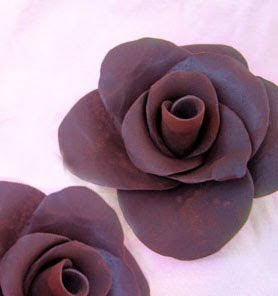
Chocolate Roses

Chocolate Roses

Chocolate Roses are beautiful and delicious lifelike flowers made out of a modeling material called chocolate plastic. Chocolate plastic recipe can be seen below or just click on the link to create the chocolate plastic for the roses.

One-half pound of white,
milk,
or dark chocolate plastic

Begin by kneading your chocolate plastic until it is smooth and supple. If you are using white chocolate plastic, knead it in powdered sugar, and if you are using milk or dark chocolate plastic, knead it in unsweetened cocoa powder. If the plastic is too hard to knead, microwave it in five-second intervals just until it becomes pliable. Do not microwave it too long, or it will be too soft to work with.

Dust your work surface and a rolling pin with powdered sugar or cocoa powder, and roll the chocolate plastic out into a very thin layer, less than 1/8” thick. If you are working with a large amount of chocolate plastic, you might want to divide it in half and roll it out in batches.

Use a small round cutter to cut circles from the plastic. For one full-sized rose, you will need nine circles, and for rosebuds, you will need 4-5. The size of the circle cutter determines the size of your finished rose. A 1.5” cutter will yield a full-sized rose that is approximately 3” wide.

Begin by forming the center of your rose: take one of the cut circles and roll it into a cylinder. Leave a small hole at the top of the cylinder, and a larger hole at the bottom.

Take another circle, and use your fingers to flatten one end of it until it is paper-thin. This will be the top of the petal, and it helps give the rose a more delicate look. Wrap your petal around the cylinder, making the top of the petal level with the top of the cylinder, pressing it at the bottom to adhere the chocolate plastic.

Thin out the edge of another circle, and overlap it over the first petal. Add a third petal overlapping the second to complete the first layer of petals. If you want to make a rosebud, your flower is now complete. To make a full rose, continue to the next step.

Use the remaining five petals to add a second layer to the rose, thinning the top edges as before, and overlapping the petals as with the first layer. Curl the outer petals back slightly to make your rose bloom. Pinch off any extra plastic at the base of the flower, and re-roll it with the plastic scraps to create more roses.

Allow the roses to sit at room temperature and dry for 24 hours. Once set, they can be stored in an airtight container indefinitely.

Friday, June 11, 2010

Melting Chocolate in the Microwave

The microwave is a great tool for melting chocolate. If used properly, it can melt chocolate more quickly than a double boiler with minimal effort and mess. The most critical part of melting chocolate in the microwave is choosing an appropriate container. Ideally, you want to melt your chocolate in a microwave-safe bowl that remains cool or only slightly warm after several minutes of near-continuous microwaving.

If the bowl is too hot for you to handle after it has been microwaved, it is too hot for your chocolate. If you have overheated your chocolate, immediately pour it into a cool bowl add chunks of unmelted chocolate, and stir continuously.

It is preferable to melt your chocolate on a low (50%) power setting, to avoid scorching or burning it. If your microwave does not have this option, heat the chocolate in shorter intervals and stir between each bout of heat. Additionally, if your microwave does not have a turntable that rotates the bowl of chocolate, manually turn the bowl each time you stop and stir the chocolate.

It is very difficult to determine exact microwaving times, as it can vary depending on microwave wattage, quantity of chocolate, and even the cocoa butter content of the chocolate.

However, as a rough guide, estimate about 1 minute for 1 ounce of chocolate, 3 minutes for 8 ounces of chocolate, 3.5 minutes for 1 pound of chocolate, and 4 minutes for 2 pounds. Run the microwave in 30 second-1 minute increments, stirring in between and rotating the bowl if necessary.

Finish heating when most, but not all, of the chocolate is melted. Stir the chocolate continuously until it is smooth, shiny, and completely melted.

Thursday, June 10, 2010

How Can I Save Overheated Chocolate?

First, you will want to cool the chocolate, as it is harder to save overheated chocolate that has been at a high temperature for a long time.

To cool the chocolate, remove the bowl from the heat source, transfer the chocolate to a dry, cool bowl, and stir in a handful of solid chocolate chunks. Stir constantly and allow the solid chocolate to bring down the temperature of the melted chocolate.

If the chocolate remains thick or lumpy, try straining it through a sieve first. If this doesn’t solve the problem, add a spoonful of vegetable oil or melted vegetable shortening and stir thoroughly.

You can also try adding some freshly melted chocolate with a few drops of soya liquid lecithin (an emulsifier, available at health food stores), or using a handheld immersion blender to smooth the chocolate. If none of these tricks helps your chocolate, save it for use in baking recipes and begin again with a fresh batch of chocolate.

What is Overheated Chocolate?

Chocolate is very sensitive to high temperatures. Dark chocolate should never be heated above 120 degrees, while milk and white chocolates should never be heated about 110 degrees. It is quite easy to exceed these temperatures if using a double boiler with boiling water, or if microwaving on full power.

Overheated chocolate will lose the silky shine of melted chocolate and become thick and muddy. The best way to melt chocolate is to keep the water in a double boiler hot (but not boiling), and to employ a chocolate or instant-read thermometer while melting the chocolate.

Thursday, May 27, 2010

Make Your Own Chocolate Candies and Lollipops

Make Your Own Chocolate CandiesMolded chocolate candies and lollipops are always great to give especially as gifts and party favors, but they can be very expensive.

Do you know that beautiful, basic molded chocolates are surprisingly easy to create at home? You can make them from Dark Chocolate, white chocolate or even cocoa powder.


Related articles:
Chocolate Varieties
Basic Equipment To make Your Chocolate
How to Melt Chocolate
Do's and Don'ts when melting chocolate
How to Make Multicolored Candies
Beginners: Filling the Molds
Simple Chocolate Candy Recipe Using Cocoa Powder
Dark Chocolate Candy Recipe